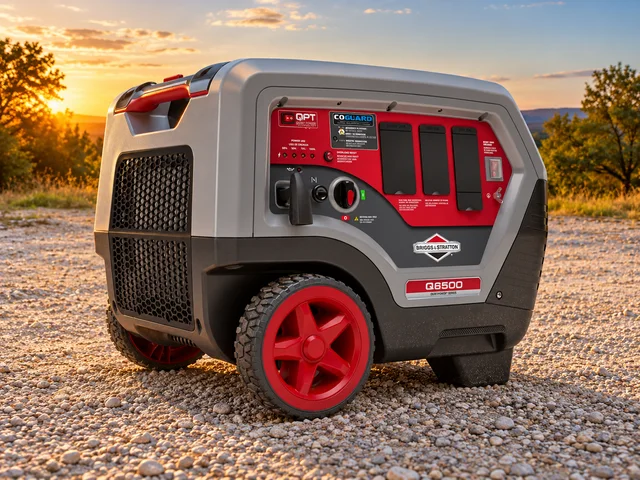
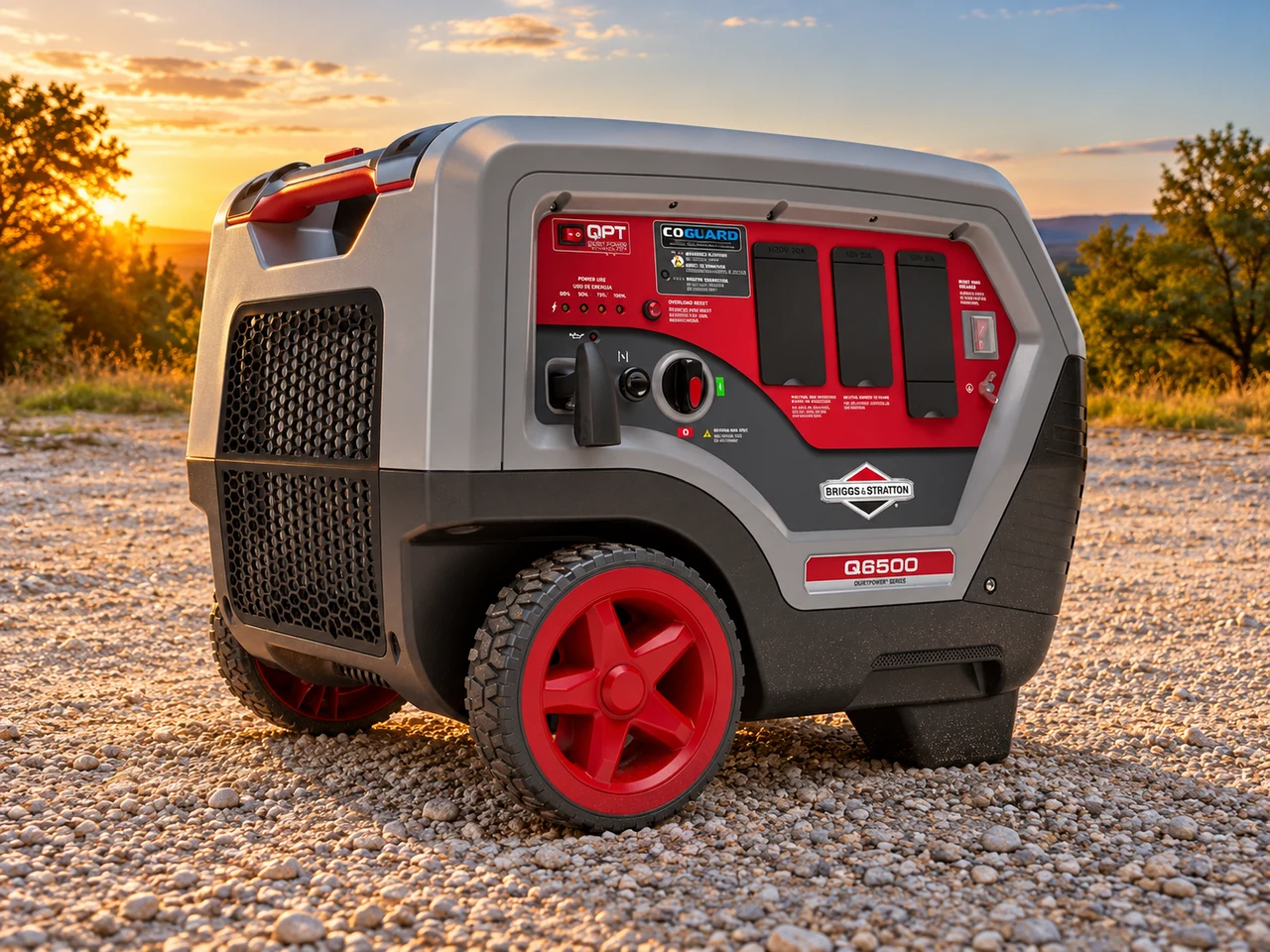
How much power does the Briggs & Stratton Q6500 30761 give you?
On gas, this model is rated for 5,000 running watts and 6,500 starting watts. Running watts are the power available while your appliances are on. Starting watts are a short burst to help things like refrigerators and pumps turn on. You cannot use that bigger number for appliances that need steady power.
| Fuel | Running watts | Starting watts |
|---|---|---|
| Gasoline | 5,000 W | 6,500 W |
The details for this model
Model: Briggs30761. Manufacturer part number: 030761. These are published specifications, not results from our own testing. If a detail is missing, we leave it marked rather than use a number from a similar generator.
- How it starts
- Not confirmed for this model
- Voltage
- 120/240V
- Gas tank
- Not confirmed for this model
- How long it runs
- Not confirmed for this model
- Weight
- Not confirmed for this model
- Size (L × W × H)
- Not confirmed for this model
- Outlets
- Four 120V 20A; two USB; 120/240V locking
- Generator type
- Inverter
- Power smoothness (THD; lower is generally smoother)
- Not confirmed for this model
- Carbon monoxide shutdown
- CO Guard
- Noise
- Not confirmed for this model
- Warranty
- Not confirmed for this model
A 120V outlet powers ordinary household plug-in devices. Some pumps and larger equipment need 240V. Inverter models use electronics to control the electricity they supply. THD measures how smooth that electricity is; a lower number generally means smoother power. Check your device instructions before connecting electronics.
Sources: Manufacturer specifications / manual ·
How long will it run?
We have not confirmed a runtime figure that says how much power was being used. The more power you use, the sooner you will need fuel. A runtime measured at 25% load means the generator was only supplying a quarter of its running power, not working flat out.
Keep approved gas containers, rotate stored fuel, and plan where you can refill them. A bigger wattage number will not help if you run out of fuel. Read our fuel-storage guide →
What can you run during an outage?
Start by listing the appliances you need most. Check both their running watts and the extra power they need to start. A refrigerator, for example, may need much more power for a moment when its compressor kicks on.
Here is an example, not a test of this generator: a refrigerator using 600 running watts, plus 100 watts of lights and 100 watts for a router and other small devices, adds up to 800 watts. If that refrigerator needs 1,800 watts to start, the total briefly reaches 2,000 watts. Your appliances may use different amounts.
That example is within the listed gasoline running and starting ratings. You still need to check your own refrigerator, each outlet’s limit, and anything else that may turn on at the same time. If you use propane or natural gas, check those ratings separately.
A 1,500-watt heater uses a lot of power on its own. Follow its connection instructions; many portable heaters must plug directly into a suitable wall outlet. For a well pump or central air conditioner, have an electrician check voltage, running power, and startup demand. A 240V outlet alone does not guarantee enough power. Work out how much power you need →
What we like and what to consider
Reasons to consider it
- A gas-only setup with no fuel switching.
- 5,000 running watts on gas.
- Inverter design, which can be useful for compatible electronics.
Things to keep in mind
- Confirm its weight before planning how to move it.
- No confirmed propane rating is available.
- There is no complete noise test to compare with other models.
What owners are saying
We do not have enough owner feedback for this exact model to give a fair summary. Reviews for a similar generator, or another option on the same Amazon page, may describe a different machine. Before buying, check recent reviews for the full model number and find out how the seller handles service and returns.
Starting, moving, and maintenance
Ask for the manual to confirm how this model starts. Practice starting it before an outage so you know you can use it when needed. Check its weight and size before deciding where to store it.
We have not confirmed the warranty for this exact model. Read the full terms, including whether your seller and intended use are covered. Follow the manual for oil type, oil changes, and storage. Keep track of running hours during a long outage. See our maintenance guide →
Other generators to compare
Champion 201513 →
This gas inverter offers more running power and a larger tank than many small carry-along models. Wheels and a folding handle help you move it, but at around 102 pounds it still takes planning to power use into a vehicle. It does not run on propane.
5,000 running watts on gas · Gasoline · 120/240V
WEN DF680iX →
The DF680iX gives you gas and propane options, inverter power, and 240V output. Plan around its 5,100 running watts on gas, rather than the larger 6,800-watt starting number. It is heavier than a small carry-along model, and an electrician should check its wiring setup before a home connection.
5,100 running watts on gas · Dual fuel · 120/240V
Westinghouse WGen5300DFcv →
This generator runs on gas or propane and has 240V output for compatible home circuits. It starts with a pull cord, so make sure everyone who might use it can start it comfortably.
5,300 running watts on gas · Dual fuel · 120/240V
Questions about the Briggs & Stratton Q6500 30761
How much running power does it provide?
5,000 watts on gasoline. Starting watts are only available briefly, not for steady use.
Is it an inverter generator?
Yes, this model is listed as an inverter generator. Check your electronics’ power requirements before connecting them.
Can I use it in a garage if it has CO shutdown?
No. Never run a generator in a garage, even with the door open. Use it outdoors at least 20 feet from homes and openings, with exhaust pointed away. Carbon monoxide shutdown is extra protection; it does not make indoor use safe.
Can I connect it to my house?
Its 120/240V output may work with a suitable home connection. Have an electrician choose and install the right transfer equipment and check the generator’s wiring setup. Never connect a generator to a household wall outlet.
Should you consider the Briggs & Stratton Q6500 30761?
The Q6500 30761 is an inverter generator with 5,000 running watts and 6,500 starting watts, according to the brand's store. It also lists CO Guard shutdown. Its enclosed design may appeal for home backup, but noise claims need matching test conditions to compare fairly.
Check Price on AmazonWhere the information comes from
We use the sources below to compare specifications and features. We have not personally tested this generator.
- Manufacturer specifications / manual
- CDC generator safety guidance ↗
- How we put our reviews together